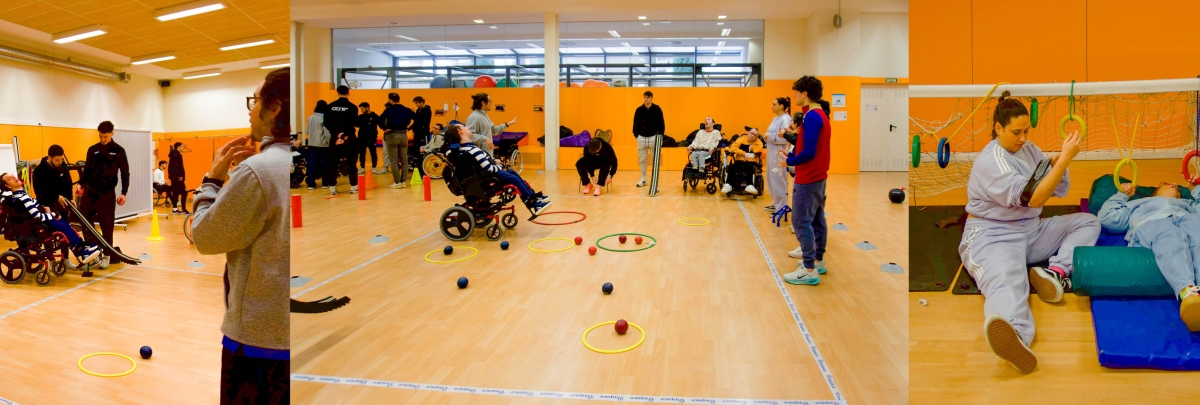
Users of the Aspace Catalunya Montjuïc Residence and Day Center shared their sports routines with Physical Activity and Sport Sciences students in a participatory session focused on adapted sports.
The Aspace Catalunya Foundation organized a training and awareness-raising day aimed at fourth-year students of the degree in Physical Activity and Sports Sciences at Blanquerna University . The activity, held at the Montjuïc Residence and Day Care Center, aimed to bring future sports professionals closer to the reality of people with cerebral palsy and to highlight physical activity as a tool for inclusion, autonomy and well-being.
One of the central elements of the day was the active role of the foundation's users themselves , who took on the role of trainers . With the support of the team of professionals from the sports service, they explained to the students the physical activities they usually practice and the coordinated work that is carried out with the sports coaches. This direct approach allowed the students to learn first-hand the objectives, dynamics and benefits of adapted sport , as well as the importance of interdisciplinary work to improve the quality of life of people with cerebral palsy.
The session also included a practical demonstration of two of the most popular disciplines among users: boccia and slalom . Through dynamic and participatory activities, students were able to interact with users, share the gaming experience and understand the technical and motor complexity required by these sports. This experience facilitated a better understanding of the adaptation strategies and challenges associated with each discipline.
The day was held in an inclusive and enriching atmosphere, consolidating itself as a space for mutual learning through sport . Both students and users gave the initiative a very positive assessment, highlighting the importance of generating meeting spaces that foster knowledge, empathy and commitment to adapted sport within university education.
According to the Aspace Catalunya Foundation, these types of activities contribute to raising awareness among future professionals and promoting a more inclusive society that is aware of the potential of all people. Direct contact between students and people with cerebral palsy is key to building a more humane and committed professional outlook, and reinforces the value of adapted sport as a space for coexistence, learning and inclusion. Initiatives like this reaffirm Aspace Catalunya's desire to continue collaborating with the academic world to generate real opportunities for integration through physical activity.