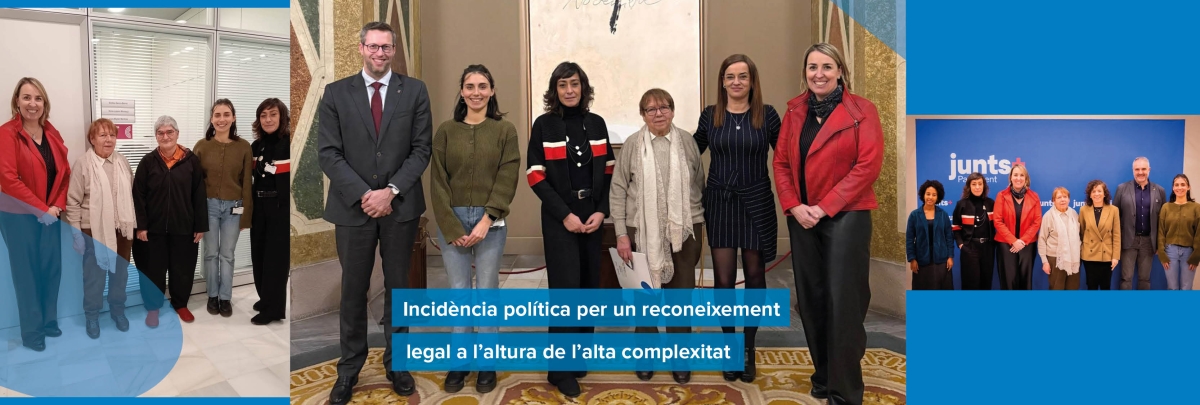
The Cerebral Palsy and Multiple Disabilities Federation of Catalonia (FEPCCAT) has promoted an institutional initiative to demand the explicit recognition of the specificity of people with cerebral palsy and multiple disabilities in the Catalan regulatory framework.
The objective is clear: for legislation to incorporate this reality as a specific type of disability, differentiated from the generic frameworks of physical and intellectual disability, to guarantee a fair, equitable public response that is adjusted to the high complexity of support that the group requires.
Political advocacy with a desire for cross-cutting consensus
In recent weeks, meetings have been held with several parliamentary groups, PSC, Junts per Catalunya, ERC and Comuns, to convey the urgent need to immediately incorporate this recognition into the current regulatory framework.
The aim is to move towards a broad and transversal consensus that allows planning, financing and the provision of services to be adapted to a highly complex reality that affects more than 55.000 people in Catalonia.
This recognition is not a terminological issue, but a political decision with a direct impact on rights, resources and quality of care.
A highly complex reality that does not fit into generic categories
Currently, Catalan legislation differentiates between physical disability and intellectual disability. This dichotomy does not reflect the reality of people with cerebral palsy and multiple disabilities, who present an inseparable combination of physical, cognitive, sensory needs and fragile health.
The data show a high prevalence, significant comorbidity and a much higher use of healthcare resources than the general population. This reality requires specific modules, appropriate ratios and differentiated planning throughout the entire life cycle.
Without specific regulatory recognition, the public response is built on generic frameworks that do not take into account the high complexity of the collective.
Aspace Catalonia Foundation: experience and institutional commitment
From Fundació Aspace Catalunya, a leading entity in the care of people with neurodevelopmental disorders, cerebral palsy and highly complex multiple disabilities, we actively contribute to this initiative.
The general director of the Foundation and vice-president of FEPCCAT, Elena Puigdevall, together with the director of Institutional Relations, Communication and Marketing, Olga González, have participated directly in the institutional work to convey this demand to the parliamentary groups.
Our experience in direct care throughout the entire life cycle allows us to provide expert knowledge and technical evidence to move towards regulation that responds to the real complexity of the group.
The recognition of specificity is not a sectoral demand, but an essential decision to guarantee effective rights, equity in access to services and sustainability of the public system.
Therefore, we demand that this step be immediately incorporated into the current legal framework through viable regulatory instruments, with a real impact on the planning and financing of services.