

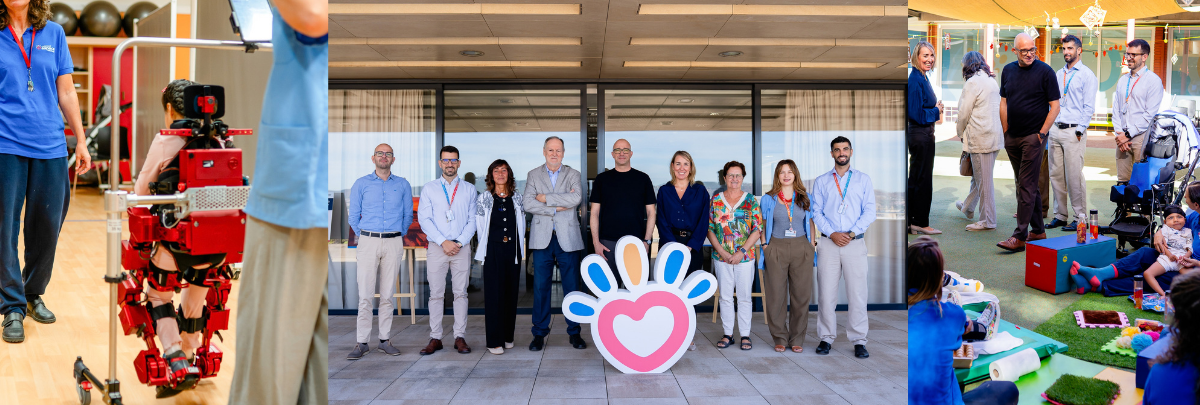
The institutional visit allows us to share first-hand the reality of people and families, to introduce Aspace Catalunya's comprehensive and highly specialized care model and to present the Alba Project, a project of the country and of public interest to respond to the present and future challenges of high complexity.
Today, Aspace Catalunya welcomed to its Montjuïc facilities Raúl Moreno, Minister of Social Rights and Inclusion of the Generalitat of Catalonia, accompanied by Carolina Homar, Secretary of Social Affairs and Inclusion, and Carme Esquirol, Director of the Territorial Services of Social Rights and Inclusion in Barcelona.
On behalf of Aspace Catalunya, they participated in the visit Enric Mangas, president of the Board of Trustees; Elena Puigdevall, general director; Carlos Varela, director of Transversal Operations and the Social Area; Tamara Biedermann, director of the Health Area; Dani Torrejón, director of the Educational Area; Albert Cantón, director of People and Values and of Economy and Finance, and Olga González, director of Institutional Relations, Communication and Marketing.
The visit allowed share closely the reality of people with neurodevelopmental disorders, cerebral palsy and multiple disabilities, the needs of their families and the challenges posed by care in highly complex situations.
From the very beginning, the minister has shown particular interest in get to know in depth the profile of the people who work at Aspace Catalunya, their support needs and how these evolve throughout the different stages of life.
Raúl Moreno also wanted to delve deeper into the reality of Aspace Catalunya, the complexity of the care offered by the Foundation and the need to continue supporting the entity so that it can respond to the present and future needs of people and their families.
To Elena Puigdevall, general director of Aspace Catalunya, «this visit has allowed us to share a reality that we know very well: when we talk about high complexity, we are talking about people and families who need very specialized responses, but also continuity, coordination and the peace of mind of knowing that we will be by their side throughout their lives. This is the model that we wanted to share with the minister today and it is also the model that we want to consolidate and grow with the Alba Project.».
A model that accompanies each person throughout life
During the tour, the delegation visited different spaces and areas of care provided by the Foundation: the aquatic and neurorehabilitation space, the Special Education School and Day Hospital for 3 to 21 years old, Petit Aspace-Day Hospital for 0-3 years old, the Specialized Outpatient Care Area, the Occupational Day Center and the residential environment.
The tour has allowed us to show on the ground what the Aspace Catalunya comprehensive care model: accompanying each person and their family in the different stages of life, integrating the health, social and educational dimensions and adapting the supports to the needs of each moment.
Because needs change. They change when a child grows, when they reach adulthood, when their health situation becomes more complex or when the family's reality also changes. This is precisely where the Aspace model makes sense: to be there, to provide continuity and to adapt the support to each person and to each moment of their life.
Comprehensive, specialized and personalized care, with the capacity to respond to highly complex situations and maintain continuity of support throughout the entire life cycle.
Listening to families to understand reality
One of the most special moments of the visit was the meeting with three families and professionals from Aspace Catalunya, a space designed to bring the counselor closer to the daily reality of people with complex support needs.
The families have directly shared their experiences, the difficulties and challenges they have faced over the years and what it means for them to have specialized and continuous support.
During the conversation they particularly highlighted the peace of mind of feeling accompanied and listened to, and of knowing that they can count on Aspace Catalunya when needs evolve or new difficulties appear.
The minister listened to their experiences and was interested in very specific day-to-day issues, the support they need and the impact that highly complex situations have on both people and their family environment.
The meeting allowed us to go beyond data, services and indicators and put at the centre what it means to live with complex support needs and the importance of having specialized, coordinated and continuous support over time.
Alba Project: a project of the country and of public interest
The visit culminated with the presentation of the Dawn Project, the project for the new Aspace Catalunya facilities in Montjuïc.
The delegation was able to learn about the architectural project, the plans and the planned location of the future building, as well as the vision behind it.
The Alba Project was born, precisely, from many of the needs shared throughout the visit: people who require increasingly specialized responses, families who need continuity and a model that must be able to evolve and grow to continue responding.
The new center will allow consolidate and expand Aspace Catalunya's comprehensive and highly specialized care model, with spaces prepared to face the challenges of the coming years and continue to advance in care, innovation and coordination between the health, social and educational spheres.
But Alba goes beyond the Foundation's needs. It is a project of the country and of public interest., designed to respond to a shared challenge: guaranteeing quality, specialized, comprehensive and continuous care for people with complex support needs and their families.
Alba is much more than a new building. It is the opportunity to prepare Aspace Catalunya for the future, to grow a model of care that puts the person at the center and to strengthen the capacity to respond to increasingly complex needs.
Today's visit has allowed, above all, share a reality, listen to people and families and look together towards the future.
A future that requires specialization, continuity, innovation and joint work between families, professionals, entities and administrations to continue building the answers that people need at each stage of their lives.
Because responding to high complexity is, above all, ensuring that each person can count on the support they need, today and throughout their life.


