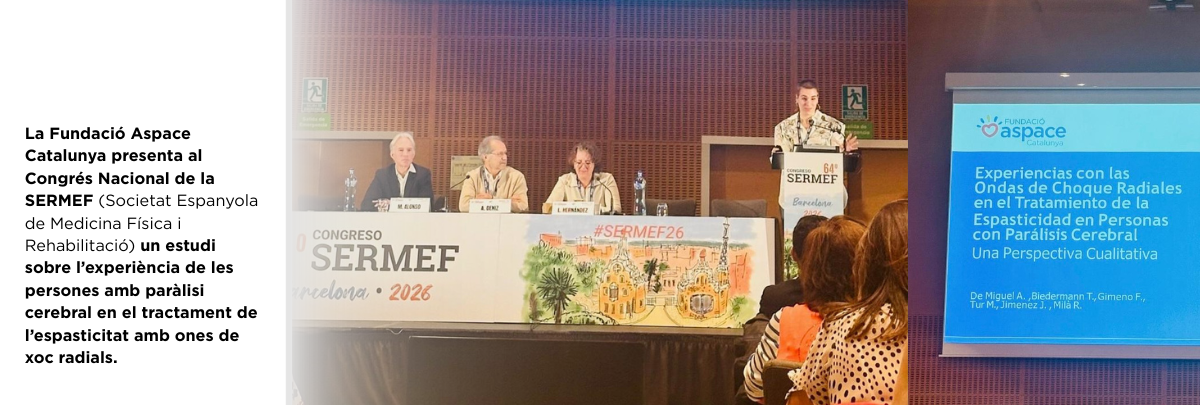
A study presented at the SERMEF National Congress analyzes how people with cerebral palsy and their families experience radial shock wave treatment, contributing to a more people-centered and evidence-based rehabilitation.
Barcelona hosted the National Congress of the Spanish Society of Physical Medicine and Rehabilitation (SERMEF), the main scientific meeting of the specialty in the State. In this context, Fundació Aspace Catalunya presented research that focuses on an often invisible aspect: the experience of people receiving treatments and their families.
Dr. Alba de Miguel Pascual , the entity's rehabilitation physician, presented the study "Experiences with Radial Shock Waves in the Treatment of Spasticity in People with Cerebral Palsy: A Qualitative Perspective" , developed jointly with Tamara Biedermann, Francisca Gimeno, Miriam Tur, Jordi Jiménez and Raimond Milà.
When research incorporates people's voices
Spasticity is one of the most frequent manifestations in many people with severe neurodevelopmental disorders and cerebral palsy . This alteration can affect mobility, functionality and participation in daily activities, directly affecting quality of life.
In recent years , radial shock waves have attracted growing interest as a therapeutic option to address this condition . However, there is still a need to expand the available knowledge about their results and how this treatment is experienced by people who receive it.
The study promoted by Aspace Catalunya provides a differential perspective because it does not focus solely on clinical outcomes. The research collects the perceptions, expectations and experiences of people with cerebral palsy and their primary caregivers, incorporating their voice in the evaluation of a specialized therapeutic intervention.
More knowledge to improve care
Understanding how people experience a treatment allows professionals to have more complete information when assessing its benefits and adapting interventions to the real needs of each situation.
In practice, this contributes to moving towards a more personalized rehabilitation , which combines scientific evidence with the direct experience of individuals and families. A perspective that is especially relevant in highly complex contexts, where each therapeutic decision can have a significant impact on the well-being and participation of the person in their day-to-day life.
A model that combines specialization and person-centered care
Participation in scientific spaces such as the SERMEF National Congress reinforces Aspace Catalunya's commitment to applied research , continuous improvement and the generation of knowledge in the field of rehabilitation.
This work is part of the entity's comprehensive care model, which combines high specialization, scientific rigor and a person-centered approach. A model that promotes the incorporation of the voice of the people being cared for and their families to continue moving towards care that is increasingly tailored to their needs and aimed at generating a real impact on their quality of life.